The Challenge

Our Strategy
Research by Georgia Policy Labs at Georgia State University found that Achieve Atlanta Scholars are more likely to persist and earn a postsecondary credential than similar peers, and they do so while taking on less student debt.4 Yet, even with this success, external factors and systemic barriers impede our students’ progress.
Achieve Atlanta’s policy strategy aims to drive systemic change at the state, federal, and local levels, ensuring that policies complement our efforts and remove barriers for our students.
Our 5 Policy Priorities

Help Georgia’s Students Afford Postsecondary Education
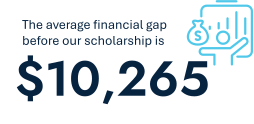
On average, tuition and fees account for only 32% of the total cost of attendance at a public institution in Georgia5, leaving students and families to cover the rising costs of housing, food, transportation, and supplies. The newly-created need-based Georgia DREAMS Scholarship has the potential to significantly impact whether students can afford these costs. At its current funding level of about $12.5m annually, only an estimated 4,000 students will receive the maximum award amount—a gap that leaves out tens of thousands of college students from low-income backgrounds across the state.6
Our recommendation: Increase the state’s investment in the DREAMS Scholarship to expand the program’s reach and support more students with financial need.

Increase Access to College and Career Counseling for High Schoolers
Currently, Georgia’s K-12 funding formula supports a student-to-counselor ratio of 450:1, yet the American School Counselor Association recommends a ratio of 250:1.7 Given the complexities of navigating the college application and financing process, targeted and intentional college and career advising can make or break a student’s ability to access higher education.
Our Recommendation: Reduce the student-to-counselor ratio and fund evidence based advising programs already succeeding in Georgia.

Strengthen Credential Completion and Workforce Alignment
Paid internships, apprenticeships, and other work-based experiential learning opportunities motivate students to persist through college and provide pathways for students to enter the workforce. However, because many work-based learning opportunities remain unpaid or inaccessible, students from lower-income backgrounds are less likely to participate in these opportunities.8 In Georgia, only 36% of students at public four-year institutions have participated in a paid internship opportunity, while at two-year institutions, that number goes down to 7%.9
Our Recommendation: Expand access to work-based learning opportunities to align with Georgia’s workforce development goals.

Increase the Transparency of College Admissions and Financial Aid Processes
Applying to and enrolling in college can be overwhelming for students and families. Students must complete applications and financial aid forms, compare institutions, and make enrollment decisions, often without a clear understanding of critical information. For example, research shows that 91% of financial aid offer letters do not accurately represent students’ out-of-pocket costs.10 As a result, many students struggle to determine which colleges they can afford and where they are most likely to succeed.
Our Recommendation: Ensure college application tools and financial aid communications clearly state costs and include important information, such as graduation and job placement rates, to allow students to make informed decisions.

Support College Students’ Basic Needs
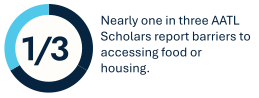
Accessing basic needs, such as food, housing, transportation, and healthcare, is a challenge for college students across the country, including in Georgia. In fact, 23% of Georgia undergraduates report facing barriers accessing food11 impacting their academic persistence and social-emotional well-being.
Our Recommendation: Expand access to basic needs supports for college students by ensuring priority housing for students from low-income backgrounds, increasing the availability of emergency financial aid, and simplifying enrollment in public benefits programs.